


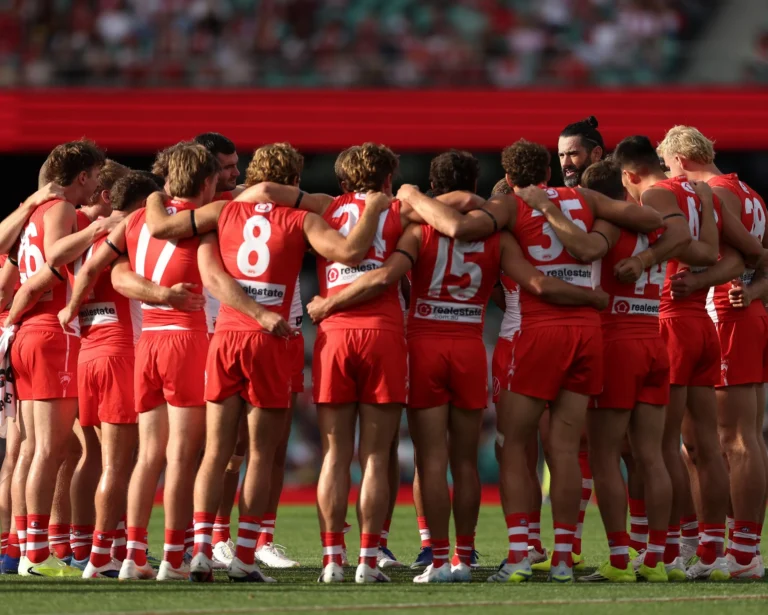
Sydney is a football club that has gained acclaim for its remarkable culture, often leveraging it as a key asset. The ideals of the ‘Bloods Culture’ were famously outlined on butcher’s paper. On the field, it emphasized hard work, selflessness, and resilience. In their encounters with the more flamboyant West Coast, they likened it to a duel between Cortinas and Ferraris. Significant figures within the organization contest the existence of a ‘no dickheads’ policy. However, off the field, premiership player Luke Ablett remarked in 2014 that the culture encompasses ‘the character traits that you aspire to. That might be training standards, recovery standards or what you do and where you go on a Saturday night.’
Challenges in the Market
The club operates in a tough market where Australian rules football does not receive the same attention as in other cities. As the late Dr. Geoffrey Edelsten pointed out, the Swans have had to adopt a different approach to stand out. They have carved out a niche distinct from the nine NRL teams in Sydney and enjoy a strong following within the city’s LGBTQ+ community. The Swans were pioneers among professional sporting teams in participating in the Mardi Gras parade. Their diversity action plan was the first of its kind in the AFL. This Sunday marks the first time both the men’s and women’s teams will compete on the same afternoon at the SCG.
Changing Atmosphere and Player Image
Experiencing a Swans home game highlights this unique atmosphere. A match is akin to a celebration. Recently, the club has shifted from the tough football style of the highly successful Paul Roos era towards a more engaging play style that appeals to a notoriously capricious audience. Their star players are not only talented but also attractive and personable, enhancing their marketability. This was crucial in the recruitment of Lance Franklin and to a lesser extent Charlie Curnow. It is exemplified by the charisma and popularity of current stars Chad Warner and Isaac Heeney.
In between scoring goals, Heeney endorses oral hygiene and teeth whitening products. He plays as if he is featured in a commercial, exuding an effortless style that suggests he could pop a champagne bottle at any moment. While we often mention graceful cricketers like David Gower, Greg Chappell, and Damien Martyn, Heeney brings his own flair to a sport that can lack elegance.

Allegations and Cultural Reflection
Heeney and Warner are part of five Sydney players who have been suspended for the remainder of the season. Although none of them have been arrested or charged, four have been linked to an ongoing police investigation concerning an alleged sexual assault at the Pullman Hotel in Melbourne early on Monday. In the wake of this news, there has been significant criticism regarding the language used by sports journalists and broadcasters. Some of the coverage has indeed been crude, a blend of sensationalism and the rush to break news. However, as writer Martin McKenzie-Murray observed in a critical piece yesterday, ‘most, if not all pundits, have earnestly pre-empted their footy-based reflections with an acknowledgment of the gravity of all this.’
This primarily remains a police matter, unfolding in various settings—bars, bedrooms, alleyways, courts, and social media—often involving acquaintances of the victim. It is central to discussions of law reform and the understanding of consent. Judges, barristers, police, politicians, bar associations, and survivors each have differing perspectives on how to ensure justice and initiate change regarding allegations of sexual assault or violence against women. This situation represents a rare instance where sports organizations have recognized their boundaries.
Yet, it also serves as a narrative within the sporting realm. It involves high-profile, well-compensated elite athletes who receive more education on consent and respectful relationships than most societal groups. It reflects the anguish of a devastated supporter base and highlights a governing body that has often failed to lead on critical issues but is now presented with an opportunity to be decisive and use appropriate language.
Furthermore, it addresses a football club that has long been regarded as a cultural model—one that has positioned itself among the most progressive in Australia. Notably, former player Brandon Jack provided insightful commentary on Bloods Culture: ‘Within the playing group, there was bloodthirsty hunger and drive that to an outsider would border on bullying. If nothing else, we were the rigorous enforcers of conformity.’
Claims of cultural exceptionalism have largely been a myth—more of a marketing strategy than a reality. It’s something that finds its way onto butcher’s paper, something pursued more diligently than what rival clubs might be attempting. These ‘young men of outstanding character’ and these commercial icons are just like any other footballer or community member—subject to the same biases, cultural influences, failings, and the laws that govern us all.
To their credit, Sydney and the AFL did not shy away from this issue. For once, the club, the industry, and the governing body prioritized community expectations over commercial interests and sporting concerns. Writing on butcher’s paper is simple. Raising a rainbow flag is straightforward. Implementing diversity action plans is relatively easy. The Swans and the AFL undertook something challenging, something rare, and something culturally meaningful, and they deserve commendation for it.
- This is an extract from Guardian Australia’s free weekly AFL email, From the Pocket. To get the full version, just visit this page and follow the instructions.