


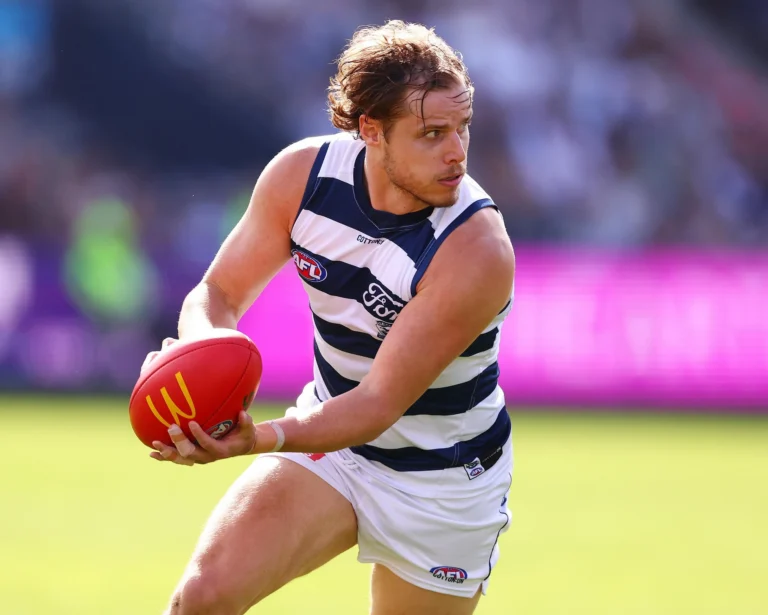
A division has arisen within the AFL regarding the capacity of clubs to avoid future responsibilities concerning head injuries. This follows Geelong’s $140,000 fine for failing to report a concussion waiver signed by defender Jake Kolodjashnij.
Details of the Penalty
The penalty against the Cats comprises two components: $100,000 for not notifying the AFL about a change to Kolodjashnij’s contract, previously referred to as a “It can’t happen and it won’t happen,” by Craig Drummond, chair of the AFL Commission and former president of the Cats.
This resulted in a $40,000 suspended fine imposed on Geelong for salary cap violations last year, culminating in a total penalty of $140,000 allocated to the AFL’s injury and support fund. The Cats reported a profit of $1.7 million in the previous year.
Geelong’s Response
In a statement released on Thursday, Geelong recognized the findings of the independent review and accepted the imposed sanction.
AFL Chief Executive Andrew Dillon asserted that a concussion waiver akin to Kolodjashnij’s would not receive approval if presented to both the AFL and the AFL Players’ Association (AFLPA) as required. “What would have happened is there would have been a line of inquiry and the AFLPA would have been involved.” he stated. “significant set of discussions”
Shortly after, Drummond offered a less definitive response. Initially, he claimed ignorance of Dillon’s comments but later added that whether such a waiver would be approved was a “protocols and the process for these types of situations” question.
Future Discussions on Concussion Protocols
When faced with the contradiction between his viewpoint and Dillon’s, Drummond noted that there would be a “I certainly, as chair of the AFL, I don’t want any of our clubs or any of our players being put in this situation,” among the AFLPA, the AFL, and clubs regarding the “We need some clarity around where there’s been a bit more grey, we need a bit more clarity.”
“The challenge that’s facing the industry as a whole is how risk is looked at, how the insurance is looked at, and how the safety net for the players and officials is looked at, so, that’s where we’re at now.” he remarked. “It is clear this incident goes beyond the breach of lodgement rules, and has raised broader issues to do with informed consent in playing contact sport and the paramount responsibilities for players’ health and safety.”
Drummond appeared to reference a review addressing concussion safety nets that the AFL and AFLPA also announced today. This review tackles issues such as the complexities surrounding commercial insurance coverage for players and officials, as well as an expansion of the injury and support fund.
Dillon indicated earlier that the AFL must improve its risk management strategies for players, board members, clubs, and medical staff.
“the mistakes made in this very complex situation” he noted.
The clause in Kolodjashnij’s contract was formulated and signed after he was not fully cleared by the AFL’s concussion panel in 2024. This followed discussions about the risks associated with his return to competitive football, involving the player, his family, medical professionals, and insurers. Geelong set aside the waiver shortly after its existence became public knowledge.
Although the AFL Commission concluded that the Cats did not intend to conceal the agreement, it accepted the recommendations from an investigation led by Kings Counsel James Peters.
Commission member Paul Bassat stated that despite the penalty for the “It’s not the board’s role to lodge documents or arrange where the documents end up going,” Geelong acted with its players’ health and safety in mind. “Management clearly made a decision not to lodge the document, but it was clearly a conscious decision because they didn’t feel that they needed to lodge the documents,” he remarked.
The penalty exceeds recent fines levied by the AFL, including a $77,500 penalty on the Cats for salary cap violations, of which $40,000 was suspended. Additionally, a $75,000 fine was imposed on Carlton for mishandling Elijah Hollands’ mental health situation.
However, this amount is minor compared to the compensation past players are likely to pursue from the football industry in a class action related to head injuries. Former Cat Max Rooke leads this case, which involves over 100 former AFL players and is expected to go to trial next year.
Geelong has faced significant criticism for establishing the waiver, which has also implicated the AFL. This scrutiny has intensified since Drummond, the former Cats president, assumed the chair of the AFL Commission in March.
Drummond has already expressed regret for “The mistake made was the documentation was not lodged, and with that lodgment there may have come up conversations, presumably with either the PA (AFLPA) or the AFL.” but on Thursday, he described it as an “administrative failure” not to submit the document. “It’s not the board’s role to submit documents or determine where the documents should go,” he clarified.
“Management clearly made a decision not to lodge the document, but it was clearly a conscious decision because they didn’t feel that they needed to submit the documents,” he added.
“The error was that the documentation was not lodged, and with that submission, conversations might have arisen, presumably with either the AFLPA or the AFL.”
Drummond recused himself from the AFL’s considerations regarding this matter.