



The standout moment for Nick Watson coincided with Dustin Martin’s milestone day. On the occasion of Martin’s 300th game, complete with pop-up barbers and the opening goal, he took a moment to acknowledge the crowd by walking to all four corners of the center square. A photograph by Michael Willson encapsulated the essence of Martin as he exited the MCG, capturing the spirit of the day.
Watson’s journey had seen its share of challenges in his first season, marred by injuries, inconsistent goal-kicking, and periods in the VFL. However, during the first quarter of that June 2024 match, he anticipated a loose ball, collected it at full speed, took a bounce, maneuvered around the boundary, and delivered a perfectly weighted kick to Dylan Moore. This moment left no doubt that Watson was destined for greatness in football.
Overcoming Doubts
Despite his talent, skepticism lingered due to his height. Mark Thompson had a firm stance against drafting players under 180cm, a rule he reluctantly broke for Matthew Stokes. Similarly, Watson faced questions: Could he effectively play in the midfield? Would he grow? Did players of his stature peak at just 17? Early in the 2024 season, as Hawthorn struggled with six losses in their first seven games and Watson dealt with injuries, critics speculated that they may have wasted a high draft pick.

Impressive Skills and Impact
Hawthorn’s coach, Sam Mitchell, has specific criteria for evaluating young talents. He seeks players who excel at handballing with both hands, maintain control below their knees, and can quickly change direction. Watson impressed Mitchell during preseason training before he was drafted. The skills he displayed in that remarkable play against Richmond—technique, timing, speed, awareness, and attitude—were clear indicators of his potential, evident throughout his junior career.
Every game for Hawthorn now features Watson’s remarkable skills. He has the ability to navigate through packs and excels at ground-level play. At stoppages, particularly during boundary throw-ins, he is a relentless predator. He analyzes the situation, feints, identifies openings, and strikes. Earlier this year, on the Gold Coast, six players raced after the ball in what resembled a slow-motion relay. Watson, starting from behind, swiftly caught up and scored a goal. In a subsequent drawn match against Collingwood, Isaac Quaynor marked him closely at stoppages, resembling a security guard on alert. A slight stumble by Quaynor allowed Watson to gain a 20-meter advantage.
There are stretches in games where Watson may not be immediately visible, yet he maintains a significant presence on the field. He is the player who disrupts the opposition’s focus, whether it’s the defender trying to escape without being tackled or the match committee strategizing for the upcoming game. A fortnight ago, Fremantle opted for the speed of Brandon Walker, who had not played since early March. While Walker performed admirably, he could not counter Watson’s impact. The first notable moment occurred when Walker lost track of Watson, who seized the opportunity, burst through a pack of Dockers, and executed a remarkable volley goal. That was a shot no one else in Australia would have attempted, and no one could have stopped him.
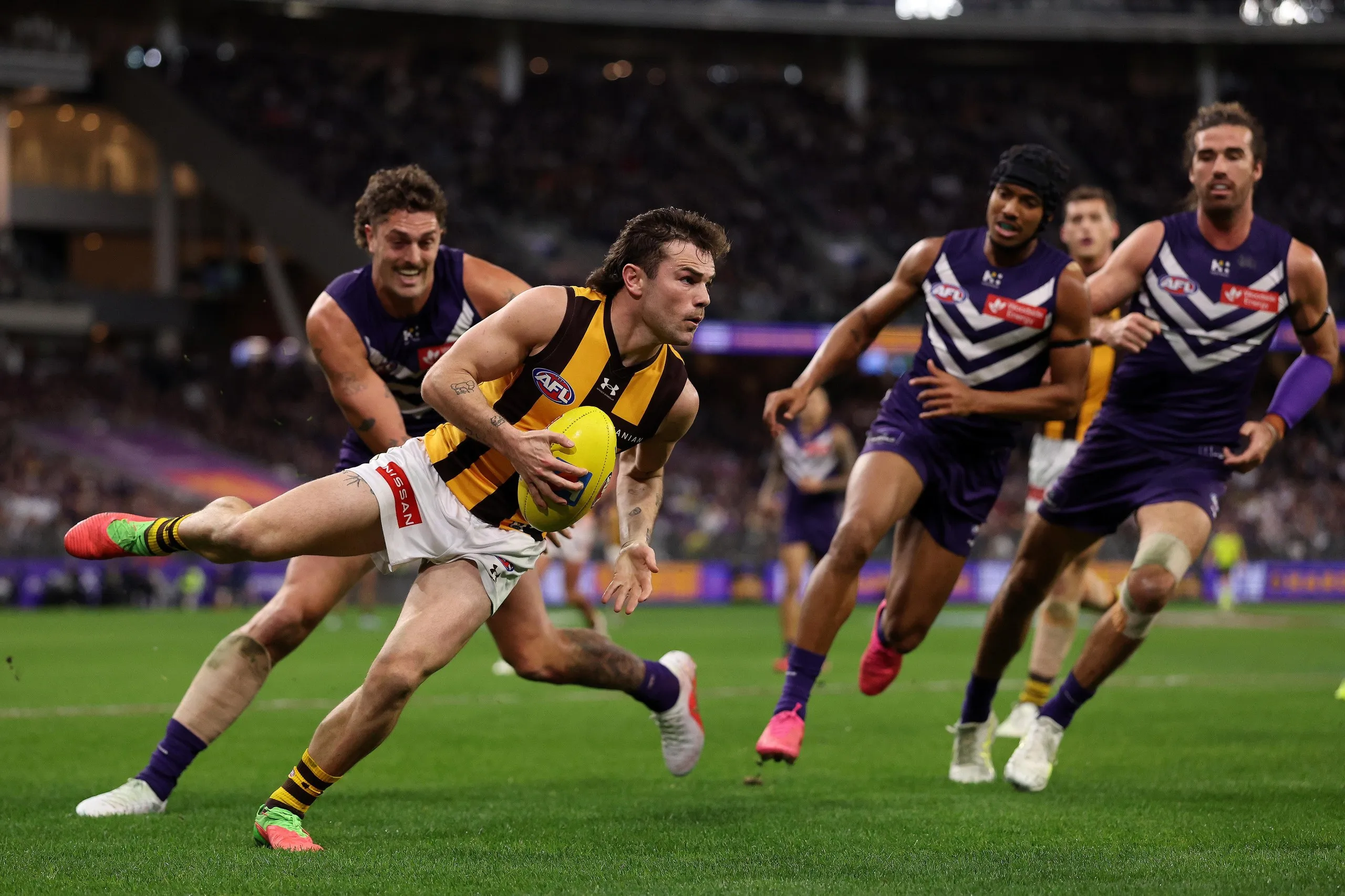
Just as Fremantle glimpsed a chance to rally, Watson swooped in on a bobbling ball and delivered a stunning kick to Jack Ginnivan. Later, Ginnivan spotted Watson 30 meters away and executed a low pass, a challenging ball to catch cleanly. Watson skillfully collected it near his shoelaces, spun to outmaneuver his pursuer, offloaded a handball to evade pressure, and set up a teammate 50 meters away, reminiscent of his earlier play against Richmond. By the end of the match, Watson’s opponent was visibly upset on the bench, while Watson was celebrating with fans, many of whom wore wizard hats.
Historically, when teams of the century were debated, small forwards were often seen as mere placeholders or soon-to-be-retired rovers. However, the role has evolved significantly over the past few decades, with players like Eddie Betts, Cyril Rioli, and Stephen Milne being recognized as the best in their field. The small forward position, whether for defensive pressure or offensive threats, has become integral to modern gameplay, prompting a reevaluation of junior player rankings. Watson, who has “do your job” tattooed on his left hand, embraces this philosophy. At just 21, he is on track to redefine the role of a small forward in ways unprecedented in football history.
- This is an extract from Guardian Australia’s free weekly AFL email, From the Pocket. To get the full version, just visit this page and follow the instructions.